Two layers
Crystals hold WHAT you know: structured, sourced, never deleted — only superseded, traceably. A soul layer learns WHO you are: your judgment, taste, and patterns.
Every other AI starts from zero. Yours starts from everything — and shows you why it believes what it says.
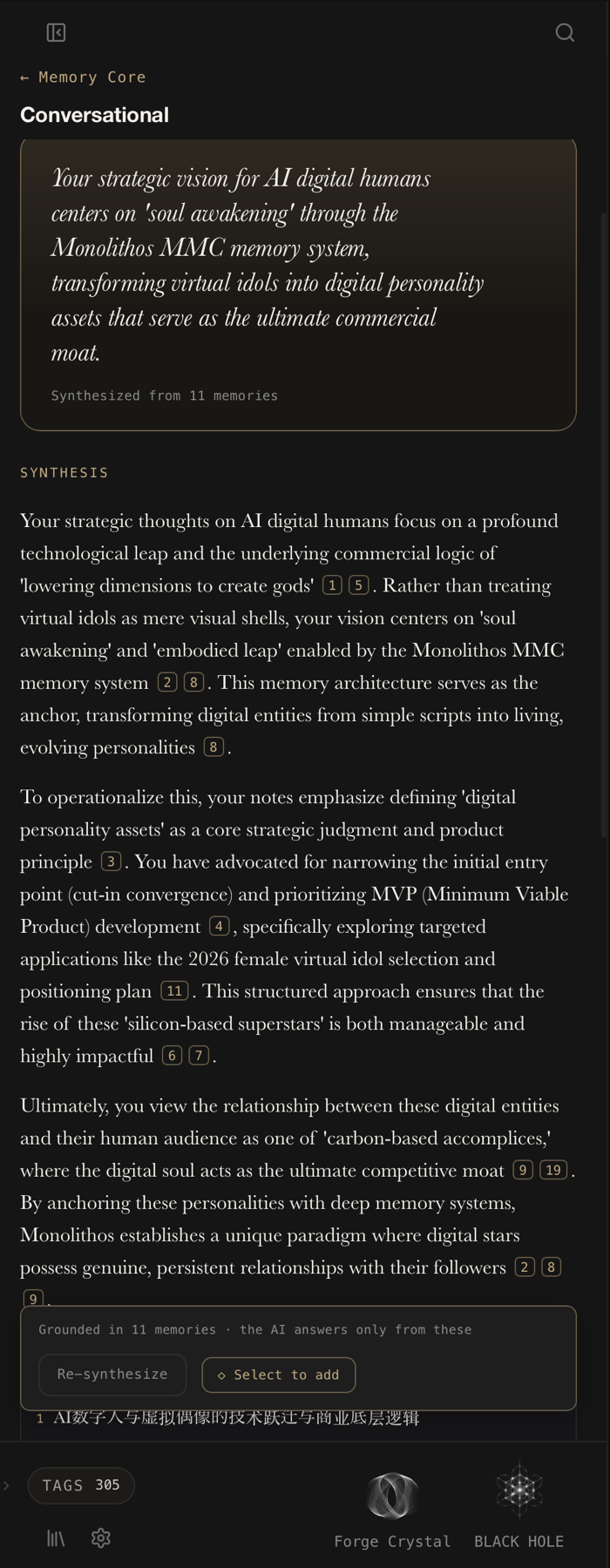
Crystals hold WHAT you know: structured, sourced, never deleted — only superseded, traceably. A soul layer learns WHO you are: your judgment, taste, and patterns.
Open the SELF page and face it: how the AI understands you, trait by trait, each traceable to the exact writing it learned from. Disagree? Mute it or delete it.
It distills your work overnight — but only proposes. Every candidate lands in your inbox; nothing enters memory without your yes.
Three retrieval layers, fixed order: exact match, knowledge layer, semantics. Certainty is never drowned by similarity. Every hit carries source, locator, and confidence.
Three live product behaviors, rebuilt from the interfaces in Monolithos. The data below is a sample; the controls and boundaries are the real ones.
SAMPLE DATA · LIVE INTERACTIONCrystallize a document yourself, or let Night Watch find worthy candidates across eight capture paths.
Automation stops at a proposal. You decide what becomes memory.
Exact matches run first, then the knowledge layer, then semantic similarity.
Inspect what the system learned about you. Mute or delete the learned trait.
Run the sample query, then open any hit. The retrieval order is fixed, and every result exposes source, locator, and confidence.
Lead with the approval boundary before automation. Trust is the launch narrative, not a footnote.
A local file is not enough. Users must be able to inspect, correct, and remove what the system believes.
Show the origin and confidence beside every recalled fragment so certainty is visible.
Monolithos does not pour every recall into the same list. Ask for a judgment and it composes a sourced digest. Ask across a period and the same memory becomes a timeline. Intent and result shape choose the Skill.
Summarize my core judgment on AI autonomy.
You did not become less ambitious. You moved the ambition from what AI may do to what it must be able to explain.
In February, speed was the throne: a product had thirty seconds to astonish before it had earned the right to explain itself.
By May, a flawless-looking prototype exposed the cost of theater: the interface said it was reading a project while the model received only filenames. “A beautiful lie is still a bug” became the new bar.
By August, the position was no longer anti-automation. It was sharper: let the system discover aggressively, but make consent the last irreversible step.
Discovery may be automatic. Agreement never is. The system can bring you a candidate; only you can turn it into memory.
memory/sovereignty-contract.mdTrust stopped being a promise and became three visible fields beside every hit: source, locator, confidence.
design/recall-receipts.mdThe project screen looked complete, but the model had received filenames instead of content. From that day, visual success without execution truth counted as failure.
decisions/project-mode-postmortem.mdThe first instinct was pure velocity: earn attention in thirty seconds, explain the machinery later.
journal/2026-02-14.mdEach trait is learned from your own writing, never from AI output. Open one to see its evidence, then exercise the same sovereign controls: mute or delete.
SIGNAL“Cut any feature the user cannot reproduce in the shipped app.”
SIGNAL“Gold is a signal, never wallpaper.”
SIGNAL“Write the red line first; implementation follows it.”
Night Watch can distill writing and discover connections in the background. Its output is always a proposal: rejecting writes nothing; accepting creates the memory.
A recurring principle across three decisions: the system must stop before user authority begins.
Document properties and content fingerprints preserve membership when files are renamed or relocated.
Exclude generated text from the evidence surface to prevent the model learning from its own echo.
The record lives with your files. Organization stays legible, corrections stay possible, and archived memories always have a way back.
Markdown project membership is stored in the document's own properties, so it survives a move, a new machine, or another compatible editor.
PDF and audio membership uses both path and content fingerprint, keeping the record intact when a file moves in Finder.
AI-generated output and private-domain folders never enter the evidence used to infer who you are.
No. Your vault never leaves your device; Monolithos servers only route the AI calls you choose to make.
Your files are plain Markdown on your disk. Everything stays readable, forever.
Natively. Monolithos works with the same files, and both apps can stay open side by side.
Your memory should compound — without leaving your ownership.
